
June 20: Tongue-tie in babies

June 20: Tongue-tie in babies

The topic of Tongue-tie often comes up in discussions in my baby massage classes so I thought that you may be interested in this article which discusses tongue tie (ankyloglossia) and the impact it has on babies in breastfeeding.

What is tongue-tie? Tongue-tie, or ‘ankyloglossia’ to give it its medical term, describes a condition that affects the way the tongue moves in the mouth.

For some babies (between 3 &10%), their frenulum, the cord-like skin joining the underside of the tongue to the floor of the mouth, limits the movement of their tongue. This is called ‘tongue-tie’. It often means that the baby can’t stick their tongue out beyond their lower lip, and may not be able to move it fully up and down or side-to-side. Some babies suck extra strongly to compensate for the restricted tongue movement.

In the most easily visible tongue-ties, the frenulum is joined to the tip of the tongue, which looks heart-shaped when the baby tries to extend their tongue, but the frenulum can be joined anywhere along the underside of the tongue.

What problems does tongue-tie cause for babies? Some babies with tongue-tie have difficulty breastfeeding and, occasionally, a bottle-fed baby with tongue-tie has difficulty feeding too.

To breastfeed effectively, babies need to latch onto both breast tissue and nipple, but babies with tongue-tie may not be able to latch on properly. Some babies with a tongue-tie seem unable to open their mouths really wide. Not only can this can result in feeding difficulties for the baby but also squashed, sore and damaged nipples for mum. Improving the baby’s latch is sometimes enough for them to feed well and for mum to find breastfeeding comfortable, so action is not always needed if a baby has tongue-tie.

Bottle-fed babies can have difficulty in creating a good seal on the teat which can result in ineffective sucking. This may lead to milk leaking out of their mouths and them swallowing air, resulting in a ‘windy’ baby.

If you think your baby may have a tongue-tie, or if you have unexplained feeding problems, do ask an infant feeding specialist, breastfeeding counsellor, your midwife or health visitor to check. Perhaps look yourself.

The impact of tongue-tie was overlooked for much of the latter part of the 20th century and some healthcare professionals may not be confident in what they’re looking for. Do keep asking questions or request a second opinion if you’re not entirely satisfied after your baby’s first check.

Tongue tie symptoms: Can I see if my baby has ankyloglossia? If you look into your baby’s mouth when they are yawning or crying, you may be able to see a tie. Tongue-ties at the back of the tongue (posterior) are much harder to see than the ones tying the tip of the tongue. However, the effect on feeding is not related to how easy it is to see the tie. Some babies with the frenulum attached near the tip of the tongue manage to breastfeed well, while others with a small tie that is hard to see may really struggle to feed.

Do I need to have my baby’s tongue-tie fixed? Not necessarily. If your baby appears to have tongue-tie, but neither you nor your baby is experiencing any problems then you don’t need to do anything.

Tongue tie treatment: What can be done to treat my baby?  The frenulum can be cut (sometimes called ‘divided’) by someone trained to do the procedure. It’s quick and simple, and young babies usually don’t need any pain relief. The procedure releases the tie, and allows the tongue to move more freely. It is preferable if the baby goes to the breast immediately after the tongue-tie division, as breastfeeding is both calming for them and provides an opportunity to try out their freer tongue movement.

Although some babies may cry briefly, the procedure doesn’t seem to cause discomfort or distress. As with all procedures, there are some risks, such as significant bleeding rather than a few drops of blood when the cut is made, but the chances of this happening are small. The procedure is normally only carried out if it seems very likely that feeding will improve as a result.

How can I find someone who would do this? Ask your health visitor, midwife or local breastfeeding counsellor. At present, the procedure is only available in some places through the NHS, and the service is variable so treatment may be offered within a week or two or your baby may be put on a waiting list.

It is important to seek help quickly though as a tongue-tie causing problems needs to be treated promptly, so that baby can feed properly and, if mum is breastfeeding, that this is comfortable for her.

There are private tongue-tie services offered in some areas. As with all private services it’s important to check the practitioner’s background and qualifications.

Does the treatment resolve the problems? Yes, research has shown that if babies have difficulty breastfeeding due to a tongue-tie, division results in improved feeding for the majority of babies.

Occasionally, a tongue-tie may need snipping more than once, because of a tendency to re-attach. Often a baby’s feeding can be improved if their parents are also shown how to do oral exercises that encourage them to move their tongue.

Further information:

NCT’s helpline offers practical and emotional support in all areas of pregnancy, birth and early parenthood: 0300 330 0700.

Jun 15: Colic – a Father’s Perspective

Jun 15: Colic – a Father’s Perspective

An interesting article for parents everywhere – Colic: a Father’s Perspective

Read one man’s diary about how he and his wife managed their babies Colic symptoms.

 
There is a memorably dark scene in the cult classic movie Office Space when the main character, while visiting his therapist, describes just how bleak his life is — he essentially says that every day is worse than the last, thus every day is the worst day of his life.The presumably highly trained, empathetic therapist, replies, “Wow, that’s messed up, man.”That scene pretty much describes my life — and the level of expert help I received — when my son Christopher went through colic earlier this year.According to WebMD.com, a baby who cries more than three hours a day more than three days a week for at least three weeks in a row has colic. And unlike why most babies cry (they’re tired, hungry or have a dirty diaper), kids with colic cry inexplicably.

My son exceeded the daily three-hour threshold with regularity. During his peak, my wife kept a log, hoping to discover some patterns. On his worst day, outside of sleeping and nursing, Christopher didn’t cry for a grand total of two minutes.

And colic crying isn’t like “I’m upset,” crying; it’s “emotionally disturbed” crying. Christopher’s face would writhe with apparent pain. He’d contort his body violently and sweat — like a panicked adult sweats. By the time I’d get home from work most days, he looked like he’d just gotten back from Afghanistan.

Christopher’s senseless crying was incredibly difficult to endure. On top of the regular newborn workload, i.e. feeding and changing him a dozen times a day while trying to squeeze in small increments of sleep around his day/night confusion, my wife and I were in a constant state of staving off crying. I remember experiencing such hopelessness that I told my wife, “I feel like I have nothing to look forward to.”

What made matters worse was finding out how poorly colic is understood by the medical community. “Unfortunately, there is no definite explanation for why [colic] happens,” says the American Academy of Pediatrics on its website, despite the fact that it affects one fifth of children. When we went to Christopher’s pediatrician in search of answers, his answer was essentially, “Sorry, you’re going to have to ride it out. Try giving him some tea.”

In fact, doctors aren’t even in agreement about what colic is, let alone what causes it.

One theory is that some babies’ stomachs are so underdeveloped that they have either constant painful gas or heartburn, which causes them to scream in agony. A 2009 study released by The University of Texas Health Science Center at Houston theorized that a naturally occurring organism called klebsiella in their intestines might aversely affect babies with colic.

The other prominent theory is that some babies are born into a “fourth trimester” outside the womb, during which their immature brains are being overloaded by the constant stream of new audio and visual stimuli; hence they cry a ton.

And just as medical experts can’t agree on what colic is, they haven’t landed upon a standard treatment plan. According to The No-Cry Sleep Solution by parenting educator Elizabeth Pantley, “There is no simple, effective treatment for colic: parents and professionals are able to offer suggestions that may help your baby through this time period” — or they may not.

You know things are bad when a doctor uses the word “try.” Doctors don’t say, “You might try amoxicillin for your infection”; they say, “Take these pills for 10 days.” In our case, we knew “try” was code for, “We really don’t know what causes what you have or what to do about it. Good luck.”

But given our desperation, we did any suggestions doctors had for us. I can’t tell you how many snake oil stomach-soothing products (like gripewater) we tried to no avail. They typically helped for about 15 seconds — the time it took Christopher to drink the useless liquid.

After a while we realized that Christopher’s colic episodes weren’t consistently tied to eating, which made me lean toward the fourth trimester theory — and to The Happiest Baby on the Block, a hugely popular book which many people recommended to us. To pediatrician and author Harvey Karp — I would love to punch you in the groin. Happiest baby, my ass. It should be called Five Random Techniques That Might Work but Could Also Do Serious Physical Damage to the Parents.

According to Karp, the five techniques (which each conveniently start with “s”) are swaddling — which screaming babies just love — swinging, shushing, placing a baby on its side, and having him suck on a pacifier. Yes, many parents swear by Karp’s techniques. And sure, your baby will stop crying if you wrap him like a mental patient in a straight jacket, rhythmically bouncing him in your arms while holding him like a martini shaker, and shushing him as loudly as possible directly in his ear. But just see how long you can do that in the middle of the night without simultaneously tearing a rotator cuff and having a complete mental breakdown. I recall at one point saying to my wife, after a night of fierce shushing, “I’m a little worried I’m going to get gum damage.”

And about a month into the colic — a point when I was hearing imaginary crying babies fairly regularly — I said to her, “I’m not sure how we’re going to get through this. We should think about getting some pot.” Thankfully, I reconsidered that after imagining dropping my crying baby after a few too many bong hits.

But that crazy thought process speaks to just how severely colic had affected me and my wife. That’s what still makes me mad to this day. One of the messages many doctors and books had for us was not to worry about colic, since it doesn’t do any damage, and that the kid won’t remember it. That might be true, but my wife and I remember it. And we’re damaged.

The medical community offered little help, but friends, relatives and acquaintances were no better, sometimes even seeming offended when we didn’t respond with utter joy to questions like, “How’s the new baby?” or “Isn’t this time in your life wonderful?” No, we thought, it’s actually horrible.

People almost seemed to want to deny colic or bury it under the rug — the way society used to shy away from discussing post-traumatic stress syndrome. Often we’d hear, “Oh, your baby’s just fussy.” God, I hated that one. People who like salad dressing on the side are fussy; inconsolable crying babies are tormented, and they torture those around them.

I came home with pure dread on some nights. I’d get off the elevator in our building and hear our vacuum from the hallway (holding Christopher next to a running vacuum was the only thing that actually consistently calmed him – one of the few semi-workable solutions from the Happiest Baby book). My wife would be crying, bouncing our son on one of those giant exercise balls, exhausted and nearly begging me to help.

We’d fight, of course. You can’t fight with the baby, even though you pretty much want to throw him out the window. So who else can you blame but your spouse? Or your mother, or her mother. “You’re holding him wrong!” “I’m trying!”

We still bicker more than we used to. I’m still trying to drop the 20 pounds I put on during the colic period. Most nights, after finally getting the baby to sleep, I’d retreat into our bedroom and, like the clich’d woman going through a bad breakup, I’d devour pints of ice cream or sleeves of cookies. Sure, I could have had some drinks instead, but a hangover with colic — that’s like giving yourself colic.

We’re also still more cautious than other parents we know. For months, we’d both get jumpy from just a little normal “I’m hungry” or “I’m tired” crying. It was weeks after colic was over before we started taking the baby out with friends. We still plan our lives around naps or bedtimes, and I’m sure our friends think we’re overprotective.

The truth is, during my worst moments, I hated the baby. I even told him to shut up. After nine months of hopeful anticipation, I wondered, “So this is what I get?”

Thankfully, things are so much better these days. The colic ended abruptly soon after our son turned three months old — as many of the books had promised. Even then, it took me several more months to bond with him completely, to let the irrational resentment and feeling that we’d been cheated pass. But now at eight months, Christopher is awesome — he’s cute, funny and, most importantly, happy. He cries when he’s tired and hungry and when I get him dressed — that’s about it. There really are no after effects — except for the ones still affecting us.


Jun 01: Bedtime reading

Jun 01: Bedtime reading

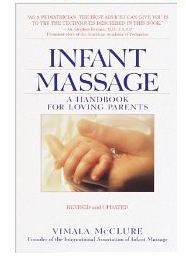
Discover the gentle art of Infant Massage…If you’re interested in learning more about baby massage and how the IAIM was started by Vimala McClure back in the 70’s then this book is for you! The International Association of Infant Massage (IAIM )is now in 71 countries!

In this completely updated version of her renowned classic, Vimala McClure, founder of the International Association of Infant Massage, and its premier proponent in the United States, helps you master the techniques of infant massage so you can incorporate this joyful and wonderful healing art into your baby’s life. She shows you why a daily massage can be one of the greatest gifts you give your child…and yourself.  For generations mothers the world over have known that the soft stroke of their hands soothes, calms, and communicates their love to their babies. Now scientific research proves that massage can do all that and more.

Infant Massage: A Handbook for Loving Parents is a beautiful book written by Vimala McClure and available from Amazon – Purchase the book that started a worldwide movement.  

May 29: course review

May 29: course review

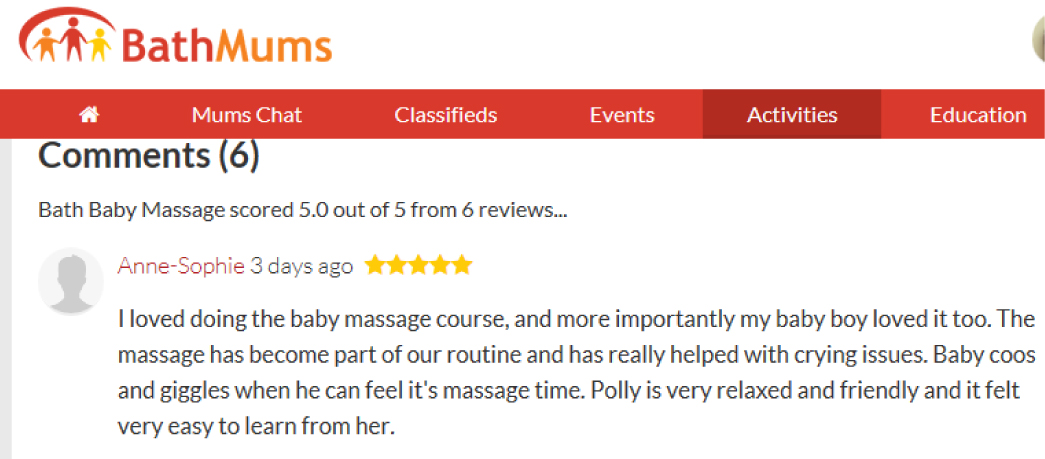
Another lovely review via BathMums from my April course!

BathMums review__2_may 2015


May 20: Class pictures

May 20: Class pictures

May 15: Infant Massage Inspires Parental Confidence

May 15: Infant Massage Inspires Parental Confidence

I recently read a wonderful article in Massage Magazine which rang so true for many of the parents attending my baby massage courses – often they ask me if it is okay that their baby cries in a session, or doesn’t seem interested in the massage that day. Persistence in baby massage when introducing it to your baby for the first time is vital! Yes they may wriggle and become fussy but it’s about you as the parent responding to your babies cues and identifying their routine so that you both adapt and learn what your baby likes. This article written by Phyllis Hanlon shares some wonderful insight.

“The arrival of a new baby can provoke both excitement and a bit of fear in even the most confident mom and dad. But in some cases, that confidence may begin to erode as baby cries, fusses, refuses to nurse or demonstrates some other upsetting behaviour. While studies have shown that massage can help calm a stressed infant, they also indicate that parental confidence can realize a boost from touch therapy with their baby.

Decades long Tradition
Vimala Schneider McClure, founder of the International Association of Infant Massage (IAIM), witnessed infant massage in an orphanage in India in 1973. The incredible benefits she saw prompted her to found her specialized organization to promote the practice. She points out that infant massage has been an integral part of caregiving tradition in many countries around the globe for decades—and for several good reasons. She asserts that, among other benefits, infant massage empowers parents, giving them the means to become experts on their own children and making them better able to respond to each baby’s unique needs.

In a paper titled “Infant Massage: Communicating Love Through Touch,” Juliana Dellinger-Bavolek, M.S.E., certified infant massage instructor, reports that parents cite increased feelings of competence in their parenting role. They also feel more capable of helping their infant relax during stressful times.

Another expert, Elaine Fogel Schneider, Ph.D., C.I.I.M., founder and executive director of First Nurturing Touch Communication, a nonprofit educational corporation that assists families as they develop safe and nurturing relationships, and Baby Steps, a family-focused early intervention program that introduces families to the world of touch and the importance of bonding and attachment as they learn to see their child first and their child’s disability second, reaffirms the confidence-boosting power of infant massage. She indicates that infant massage creates and strengthens physiological, social-emotional and mind/body/spirit connections for both parent and baby; social interaction is significant for parents’ well being, Schneider adds.

Competence and Confidence
The biggest endorsement for enhanced parental confidence through infant massage comes from Tiffany Field, Ph.D., founder and director of The Touch Research Institute, which has conducted more than 100 studies. Since 1992, she has explored the benefits of many different forms of massage and encourages the practice of infant massage as a way to promote a sense of competence and confidence for parents.

Amy Murry, certified health coach and owner of Human Body Works Massage Therapy in Olympia, Washington, finds lack of confidence a common issue with many new parents.

“I think that sometimes new parents want to do everything just right and feel like the first few times they try infant massage they are somehow unsuccessful because the baby is squirmy or fussy. They start, but aren’t sure they are ‘doing it right’ and then stop,” she says. Although they are unsure of their technique, she encourages new moms and dads to persist. “After developing a routine, both parent and baby learn each others’ quirks and bond into their routine.”

Murry notes that she massaged all three of her children as infants.“One loved to lay there and receive a long soothing massage. Another loved to try to crawl away and wrestle and giggle, and my colicky one had a very short timeline for very specific massage to his areas of tension.Consistency in practice and flexibility to one’s ideas about what you had envisioned as ‘infant massage’ is key,” she asserts.

May 09: course review

May 09: course review

It’s always lovely to get good feedback about my classes – here is a recent review on BathMums from my April course.

Course review Bath Mums


April 08: Interview with Bath Mums

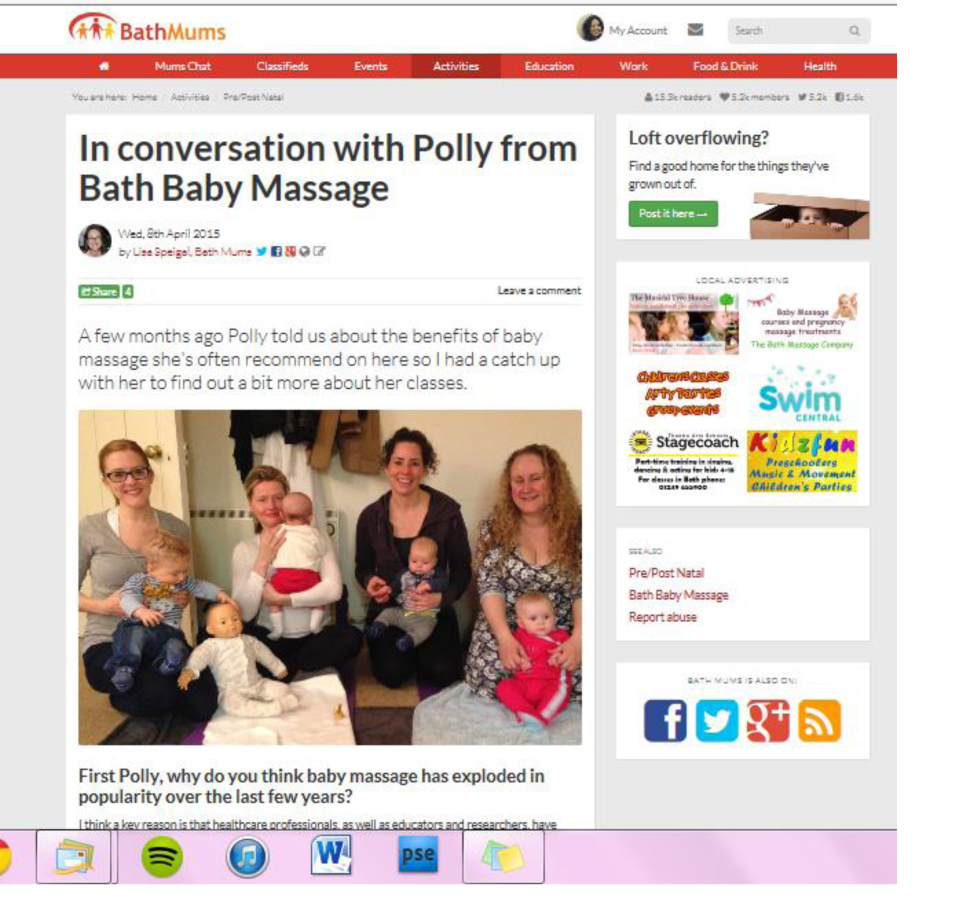
April 08: Interview with Bath Mums

I recently was asked by Bath Mums to talk about Baby Massage through an interview feature – it was launched today on their website and here it is, click the image to view….enjoy the read…
Doc1


1345677