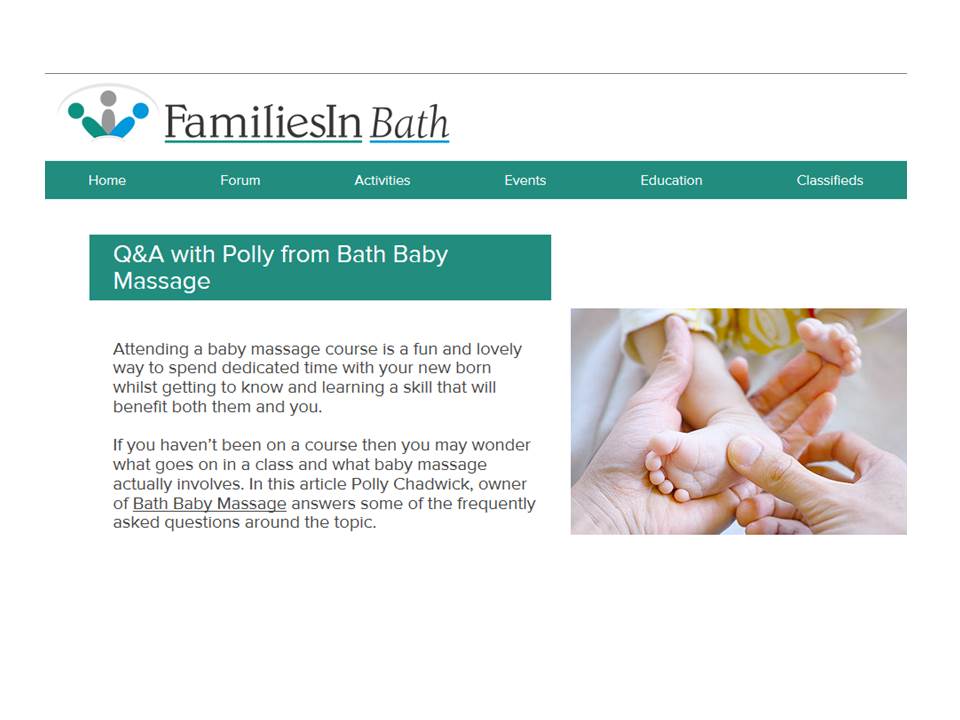
Bath’s newest website dedicated for parents – www.familiesinbath.co.uk – has kindly feature a short Q&A interview with me all about my classes, what goes on in them, and answers frequently asked questions. Read it here.
A recent study has been published about the use of sunflower oil in baby massage.
The study in question is: “OLIVE OIL, SUNFLOWER OIL OR NO OIL FOR BABY DRY SKIN OR MASSAGE: A PILOT, ASSESSOR-BLINDED, RANDOMIZED CONTROLLED TRIAL” (the Oil in Baby Skincare [OBSeRvE] Study) – Cooke A, Cork MJ, Victor S, Campbell M, Danby S, Chittock J, Lavender T
Read the full study here: http://www.medicaljournals.se/acta/content/?doi=10.2340/00015555-2279&html=1
This study does not show that either olive or sunflower oil leads to eczema, it only concludes that the lipid structure of the skin barrier “appeared altered” on the babies who used the oils. To theorise that this might lead to the development of eczema is a big leap and the study also concludes that further studies, including a “long-term observational study”, would be required to establish whether there is a possible link between the use of oils and Atopic Eczema.
Sunflower oil has been used for many years as a massage oil without any sign of problems and there are plenty of studies that corroborate the health benefits. The article below summarises over 30 studies:
SELECTED EVIDENCE-BASED HEALTH BENEFITS OF TOPICALLY APPLIED SUNFLOWER OIL – Mihaela Stoia and Simona Oancea.
Read the full article here: https://www.researchgate.net/publication/275328801_Selected_Evidence-Based_Health_Benefits_of_Topically_Applied_Sunflower_Oil
The official IAIM recommendation on oil has always been to use an organic cold-pressed vegetable oil, of which there are many different varieties available, and in the UK sunflower oil still remains the most popular one used.
An infant massage instructor should ideally provide parents with a choice of oil and allow them to decide which to use, as the IAIM belief is that the parents are the experts on their own child.
This months article for BathMums is all about sleep and how massaging your baby can really help them to relax ready for bedtime. Read it here.
https://bathmums.co.uk/posts/view/how-baby-massage-can-aid-better-sleep
I received some lovely feedback from a recent course. Feedback like this makes me happy that I decided to train as a IAIM infant massage instructor, it’s so rewarding.
“The sessions always had a very relaxed atmosphere, and I didn’t feel stressed at all about the little ones crying / wanting food etc. A really good balance of teaching / time for chatting, sharing ideas / experiences. And great to finish with tea and cake!! Really great to have a Dads session at the weekend – was a great experience for my husband”
“The course taught me so many things – how powerful massage can be in helping my baby girl to relax, she loves having her tummy massaged now, and also that I don’t spend enough time with her when she is naked – she loves it!”
“Polly is a great teacher, she took whatever was happening in her stride, and did not appear at all stressed if most of the babies were crying / had had enough. She has an amazing ability to make everyone warm to her very quickly and instantly puts people at ease, very open. (I feel like I have known you for ages!!)”
This article has been written by the IAIM’S founder, Vimala McClure’s and taken from her blogsite.
“One evening after a family gathering at which a new-born cousin had made his first appearance, a friend’s six-year-old daughter claimed into her mother’s lap. “I wish I was a baby, Mommy,” she said. “Then I’d get a lot of attention.” That was a signal, time for a bedtime rubdown. Why? Not so much because she needed more attention, but because she needed to talk about the feelings her new cousin stirred in her.
It is important for children to talk about their feelings, but sometimes it is difficult to get them to open up. Often, the more we question, the more unresponsive they become. My eight-year-old was to have surgery within a week, and though I knew he should talk about his fears, I hadn’t yet been able to draw him out. The day after we had taken a tour of the children’s ward and met the nurses at the hospital, he seemed tense. I asked him if he had any questions. “I dunno,” he mumbled, shrugging and slinking off to his room. Later that evening I offered him a foot massage. I gently massaged his calves, knees, and feet; within five minutes he relaxed and began to talk. He had several questions about the hospital and his surgery and was finally able to get the reassurance he needed — that I would be there with hi, that he would not wake up during the surgery, and that he would be able to talk after his tonsillectomy. The operation went smoothly, and I remembered to use the soothing power of touch with him throughout the experience, before and after the surgery. A foot or hand massage helped us both relax and let go of scary feelings.
Anthropologist Ashley Montagu, author of Touching, states that a child’s close relationship with his parents is a source of basic self-esteem. “Persons who are callously unresponsive to human need, who have become so hardened that they are no longer in touch with the human condition, are not merely metaphorically so,” he says, “but clearly physiologically so.” A study reported in the Journal of Humanistic Psychology confirmed this idea, indicating that the higher the subject’s self-esteem, the more he communicates through touch. Before the age of twelve, children are more tactile-kinaesthetic — that is, they use feeling more than sight or hearing for information about the world. Therefore, a warm touch can often trigger an outpouring of feeling or shouts more than verbal communication. Saying “I love you” to your child is important, but more important is communicating your love through eye contact, through focused attention, and through your loving touch. In addition, for children, when praise is accompanied by touch, it is taken in eighty-five percent of the time, whereas praise given only with words is believed or absorbed only fifteen percent of the time.
Bonding between parents and children continues a the children age. Simply because a child has graduated from the in-arms stage doesn’t mean she no longer needs your attention through healthy touching. She will no longer be nursing, she won’t cuddle in the same way, her circle of support will widen, and she will be increasingly busy exploring the infinite possibilities of her world. But as she grows out of her mother’s and father’s arms, she will come to cherish those moments of closeness that reassure her that Mommy and Daddy are always there with a warm smile and a loving massage.
Though sometime in the first nine months is the ideal time to start the massage routine, it is never too late to begin. Usually a child between one and three years of age who has not been massaged from infancy will be much too busy to be still, but you may be able to start with a short, gentle back rub at bedtime. When your child becomes accustomed to being massaged, he will begin to ask for it.
How to Begin
Perhaps you’ve never considered massage as a means of opening communication between you and your child. How do you start without making it a “big deal”? The Soccer Player’s Special (or ballerina’s, whatever suits) is a good way to being. Here’s how:
At different stages, your child will respond to being massaged differently. My best advice is to go with the flow, allowing her to lead you in the appropriate way. Here are some very common stages that children go through with massage, and what to do when your baby begins to respond differently. Of course, these ages are not rigid; each child will have his own rhythm and cycles of growth.
The Active Crawler
Active crawling is a challenging time for most parents, who are accustomed to massaging their infant as a soothing, quiet, communicative, and even meditative experience. When your baby starts crawling, massage becomes more playful and fun. Just about anything is preferable to lying on her back! You can use rhymes and games, give her a toy to play with or a hard biscuit to suck on. Instead of adhering rigidly to the sequence of stroking, just massage the part that appears in front of you. Babies will roll around, crawl, climb in your lap, sit up, and do all manner of movements. Be creative with your massage. My son and I made a game; he would start to crawl away, and I would say, “Oh, no you don’t! I’m gonna get you now!” and laugh, pulling him back toward my lap. He would giggle and want to do this over and over again. In the meantime, I massaged his back, his buttocks, his legs and feet.
The Toddler
From age one to three, your child will be developing her autonomy, and a big part of autonomy is exercising her freedom to say “no.” She may often reject massage altogether during this period. If this is her response when you offer a massage, respect her choice. Sometimes she may ask for massage is a coded way, such as “I have a tummy ache.” Then you can offer a massage. You can do the strokes in a playful way. Clara Ute Zacher Laves, an IAIM Instructor Trainer, suggests doing fun things like plating a garden on your child’s back, or making a pizza on her tummy. Use your imagination, and your child will enjoy this opportunity for creative play.
The Preschool Child
At about age three, your child will settle down and enjoy being massaged again in a more quiet way. Now that he has established his independence, he will like the feeling of being a “baby” again, receiving all of his parent’s attention. You can massage after a bath or at bedtime. Adapt the strokes to the child’s growing limbs, leaving out strokes that don’t fit or seem appropriate. Respect the modesty your child may have developed by now, and allow him to keep his T-shirt and underwear on. Tell a story as you massage legs, feet, tummy, and back, or ask your child what body part you are massaging, helping him to learn the names of different parts, such as forearm, thigh, calf, and so on. From now on, you can leave out the Gentle Movements, as your child is getting plenty of stitching and exercise in his day-to-day life.
The School-Age Child
Again, you will adapt the strokes to your child’s growing limbs, kneading the high and calf muscles as she lies flat rather than using the Milking strokes. Offer open-ended questions or statements that will encourage her to talk, such as “It seemed like you were a little sad when you came home today.” Music, story-telling, and talking can enhance the massage experience and allow time for your child to feel special and open up to you. You might add scent to your massage oil, allowing her to choose the scent. Most school-age children will enjoy the massage more if they are lying on their stomach other than face-up.
Helping an Older Child Adjust to a New Baby
A new baby is a fascinating, fearful creature to her older brother or sister. Hovered over and protected by adults, she seems an unapproachable, somehow dangerous little thing. Much has been written on the importance of letting your older child know that he is still loved and cherished in his own right when a new baby comes into the family. The next step is to help the older child and the baby begin a relationship of their own. It usually takes quite a bit longer for a child to fully bond with a new sibling. His first task is to understand that the baby is “here,” that mother is all right, that he is still loved as much as before, and that life goes on.
As you massage your baby every day, your older child will observe. He may remember being massaged (in fact, he still may enjoy being massaged), and identify with the baby. They share an experience and have something in common. If you give your child the opportunity to massage the baby occasionally (only if he wants too, of course), he will benefit by it in many ways, as will the baby. The older child will bond with the baby in the same ways that you do — with eye contact, touch, movement, and sound. He will learn that the baby is not necessarily so dangerous and fragile but a person like himself. His confidence will bloom as he comes to realize his own competence as a caregiver and protector. The baby will respond to him, overcoming her initial fear of his sometimes clumsy or rough handling, or startling behaviour. She will begin to relate to him as a loving peer and ally.
It is best to delay suggesting that an older child massage the new baby until the baby has passed through that stage of fragility when she is easily startled. Usually three or four months of age is about the right time, though a little earlier may be appropriate for an older child who is over four. Don’t worry about the techniques or whether your child uses oil. You can show him a couple of simple things (like the Open Book stroke on the chest or the I Love You stroke on the tummy), and then let him do it as he pleases. He will at first be hesitant and may need your encouragement to touch the baby. He might stroke her only a few times. But even the tiniest amount of contact will be very beneficial. Be sure to express your pleasure and pride to your child. Let him know that he did a good job and that his massaging is valuable to the baby.
The topic of Tongue-tie often comes up in discussions in my baby massage classes so I thought that you may be interested in this article which discusses tongue tie (ankyloglossia) and the impact it has on babies in breastfeeding.
What is tongue-tie? Tongue-tie, or ‘ankyloglossia’ to give it its medical term, describes a condition that affects the way the tongue moves in the mouth.
For some babies (between 3 &10%), their frenulum, the cord-like skin joining the underside of the tongue to the floor of the mouth, limits the movement of their tongue. This is called ‘tongue-tie’. It often means that the baby can’t stick their tongue out beyond their lower lip, and may not be able to move it fully up and down or side-to-side. Some babies suck extra strongly to compensate for the restricted tongue movement.
In the most easily visible tongue-ties, the frenulum is joined to the tip of the tongue, which looks heart-shaped when the baby tries to extend their tongue, but the frenulum can be joined anywhere along the underside of the tongue.
What problems does tongue-tie cause for babies? Some babies with tongue-tie have difficulty breastfeeding and, occasionally, a bottle-fed baby with tongue-tie has difficulty feeding too.
To breastfeed effectively, babies need to latch onto both breast tissue and nipple, but babies with tongue-tie may not be able to latch on properly. Some babies with a tongue-tie seem unable to open their mouths really wide. Not only can this can result in feeding difficulties for the baby but also squashed, sore and damaged nipples for mum. Improving the baby’s latch is sometimes enough for them to feed well and for mum to find breastfeeding comfortable, so action is not always needed if a baby has tongue-tie.
Bottle-fed babies can have difficulty in creating a good seal on the teat which can result in ineffective sucking. This may lead to milk leaking out of their mouths and them swallowing air, resulting in a ‘windy’ baby.
If you think your baby may have a tongue-tie, or if you have unexplained feeding problems, do ask an infant feeding specialist, breastfeeding counsellor, your midwife or health visitor to check. Perhaps look yourself.
The impact of tongue-tie was overlooked for much of the latter part of the 20th century and some healthcare professionals may not be confident in what they’re looking for. Do keep asking questions or request a second opinion if you’re not entirely satisfied after your baby’s first check.
Tongue tie symptoms: Can I see if my baby has ankyloglossia? If you look into your baby’s mouth when they are yawning or crying, you may be able to see a tie. Tongue-ties at the back of the tongue (posterior) are much harder to see than the ones tying the tip of the tongue. However, the effect on feeding is not related to how easy it is to see the tie. Some babies with the frenulum attached near the tip of the tongue manage to breastfeed well, while others with a small tie that is hard to see may really struggle to feed.
Do I need to have my baby’s tongue-tie fixed? Not necessarily. If your baby appears to have tongue-tie, but neither you nor your baby is experiencing any problems then you don’t need to do anything.
Tongue tie treatment: What can be done to treat my baby? The frenulum can be cut (sometimes called ‘divided’) by someone trained to do the procedure. It’s quick and simple, and young babies usually don’t need any pain relief. The procedure releases the tie, and allows the tongue to move more freely. It is preferable if the baby goes to the breast immediately after the tongue-tie division, as breastfeeding is both calming for them and provides an opportunity to try out their freer tongue movement.
Although some babies may cry briefly, the procedure doesn’t seem to cause discomfort or distress. As with all procedures, there are some risks, such as significant bleeding rather than a few drops of blood when the cut is made, but the chances of this happening are small. The procedure is normally only carried out if it seems very likely that feeding will improve as a result.
How can I find someone who would do this? Ask your health visitor, midwife or local breastfeeding counsellor. At present, the procedure is only available in some places through the NHS, and the service is variable so treatment may be offered within a week or two or your baby may be put on a waiting list.
It is important to seek help quickly though as a tongue-tie causing problems needs to be treated promptly, so that baby can feed properly and, if mum is breastfeeding, that this is comfortable for her.
There are private tongue-tie services offered in some areas. As with all private services it’s important to check the practitioner’s background and qualifications.
Does the treatment resolve the problems? Yes, research has shown that if babies have difficulty breastfeeding due to a tongue-tie, division results in improved feeding for the majority of babies.
Occasionally, a tongue-tie may need snipping more than once, because of a tendency to re-attach. Often a baby’s feeding can be improved if their parents are also shown how to do oral exercises that encourage them to move their tongue.
Further information:
NCT’s helpline offers practical and emotional support in all areas of pregnancy, birth and early parenthood: 0300 330 0700.